Every AI answer runs on computing power, mostly specialized chips called GPUs. Much of that power sits with cloud giants like Amazon, Microsoft and Google, and demand is expected to outrun supply for years.
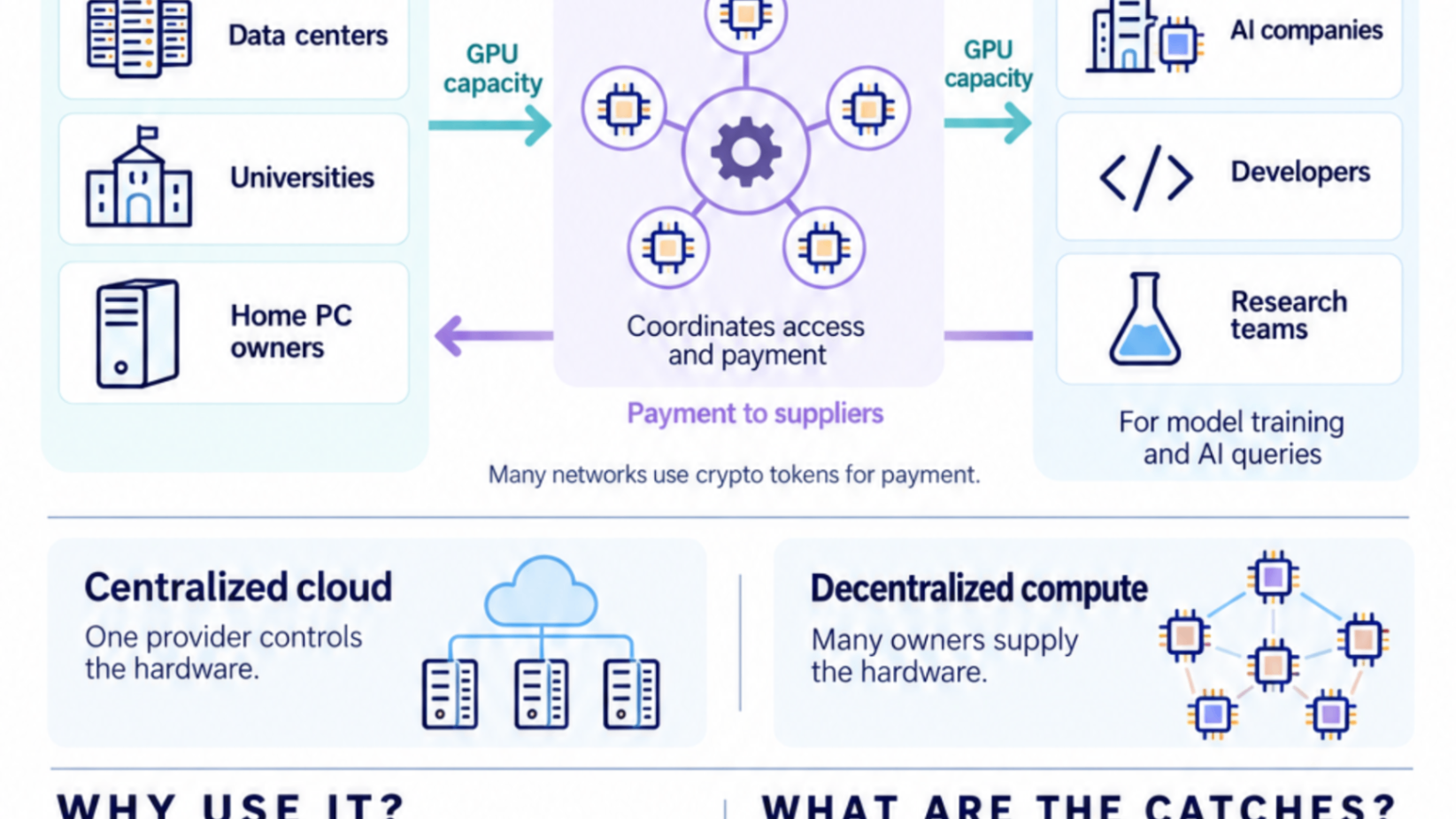
Decentralized compute takes a different route. Instead of one company owning the hardware, a network pools GPUs from many owners and rents that capacity to whoever needs it.
Those owners range from data centers to universities with idle servers to gaming PCs at home. Software matches buyers with sellers, and payment usually runs through a crypto token.
Michael Heinrich, CEO of AI blockchain project 0G Labs, put it simply on the DeAI News Journal: "If you have a graphics card, you can participate in the network." The network, he said, is "owned by whoever participates in the network."
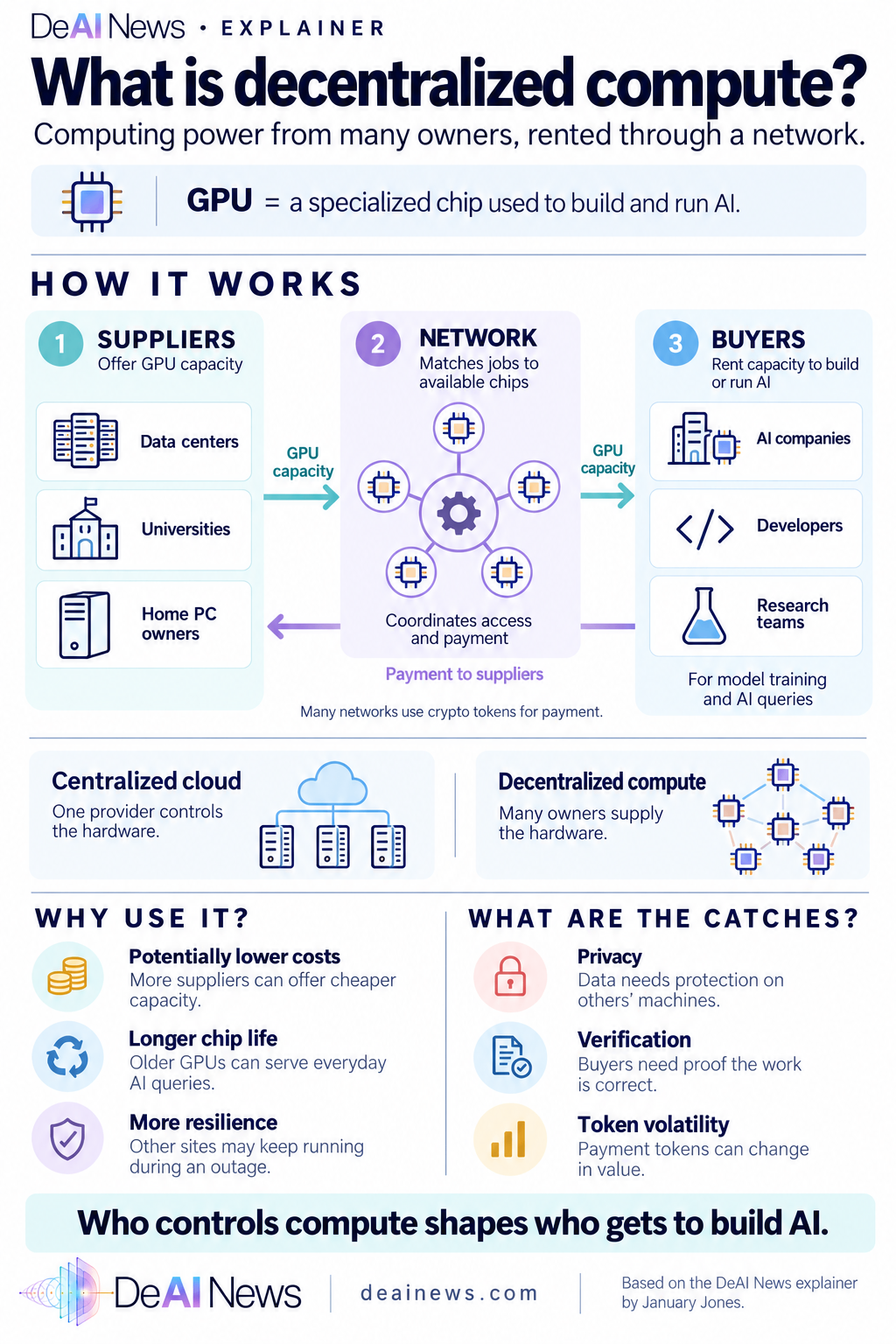
The pitch is price. Peer-to-peer computing project Ocean says it rents an Nvidia H200 for $2.16 an hour, versus $5.99 on demand at centralized provider Together AI. Decentralized GPU cloud Aethir says it offers H100-class chips at $1.25 an hour across more than 90 countries.
The second pitch is a longer life for chips. A GPU too old to train cutting-edge models can still answer everyday AI queries. Aethir argues that networks like its own give used cards a market, and with it a price floor.
The third is resilience. When computing is spread across homes and countries, one outage or attack doesn't take everything down. In a quarterly report, AI compute network Akash wrote that "if a data center in the Middle East takes a strike, nodes in Seoul and Frankfurt keep running."
The catches are real. Sending sensitive data to strangers' machines is a hard sell. Akash now runs jobs in sealed-off sections of a chip so even the machine's owner can't see the data.
Greg Osuri, CEO of Akash developer Overclock Labs, was candid that a final verification step is still in development: "We want to be straightforward instead of overstating TEE capabilities."
The crypto tokens that pay for these networks are volatile, and both Akash's and Aethir's fell sharply in 2026.
Aethir is now securing data-center sites of its own, conceding that "for four years, the decentralized GPU cloud model was defined by what it didn't own."
Why it matters. Whoever controls computing power controls who gets to build and run AI. Decentralized compute is a bet that the answer doesn't have to be a few cloud giants.
Investors are starting to take notice. Crypto asset manager Grayscale now lists Akash among the "decentralized alternatives" as AI compute turns into a financial asset.
Read more: Used GPU prices supported by decentralized AI networks, Aethir argues · Ocean expands chip-rental network to handle AI user queries · Akash says decentralized computing network now runs AI privately · Decentralized computing network Aethir pushes into data centers · 'Decentralized alternatives' studied in race to finance AI computation
HOW AI WAS USED IN THE PRODUCTION OF THIS PIECE: I drafted this explainer with Claude, which pulled the source stories from the DeAI News archive through the Distro Publisher MCP connector and applied the Distro house-style rules. I checked every quote and figure against the original stories and the DeAI News Journal transcript.