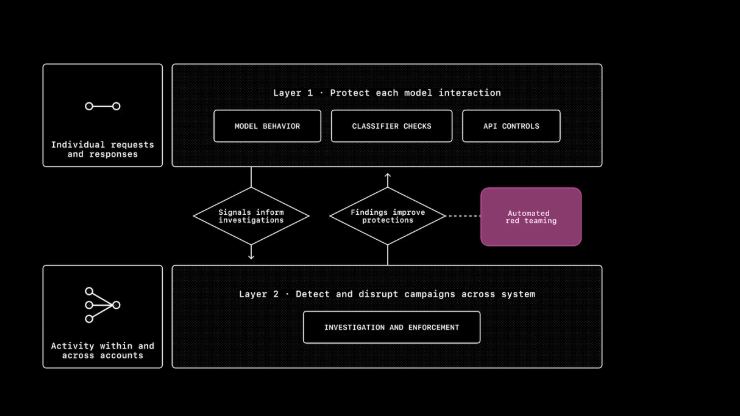
AI developer OpenAI said Friday that unauthorized efforts to copy model capabilities can reproduce them without comparable safeguards, raising cybersecurity and biology risks.
Ordinary distillation trains one model on data produced by another, often compressing knowledge into an easier-to-deploy model. OpenAI describes it as adversarial when actors use frontier-model outputs without authorization to reproduce capabilities in a model lacking comparable safeguards.
OpenAI said protected-reasoning traces can be valuable training data. If capabilities reach a model with weaker safeguards, the second model may provide assistance the original would refuse or block.
In an internal adaptive evaluation, OpenAI said success recovering protected reasoning fell from 54.0% for GPT-6 Astra with original safeguards to 0.2% for GPT-6.2 Astra with updated safeguards. The post did not present independent validation.
OpenAI’s safety rationale may be genuine, but treating output-based copying as a safety threat could affect competition.
The DeAI angle: Centralized model firms may invoke safety to restrict competitors seeking to reproduce capabilities through distillation.
HOW AI WAS USED IN THE PRODUCTION OF THIS PIECE: I used Hermes Agent, connected to a ChatGPT subscription, to draft and edit this story. I used the Distro Publisher file uploader to add the featured image. I then used the Distro Publisher MCP connector to file the story directly to DeAI News on the web app DistroVerse. I used the in-app story-editing interface to do the final edit and publishing steps.