Arthur Hayes, whose crypto exchange BitMEX in the late 2010s popularized the "perpetual swap" or "perp" contracts that have become standard across digital-asset markets, took another step last week toward his latest goal of trailblazing fast-emerging markets for AI.
In an Oct. 26 essay, Hayes unveiled what he described as the "definitive blueprint" for trading contracts that could be used to speculate on and hedge the cost of processing AI requests.
Other firms have attempted to track rental prices for in-demand computer chips, "but the data set is incomplete," according to the entrepreneur. Instead, "we should focus on obtaining information on the price of compute," Hayes wrote.
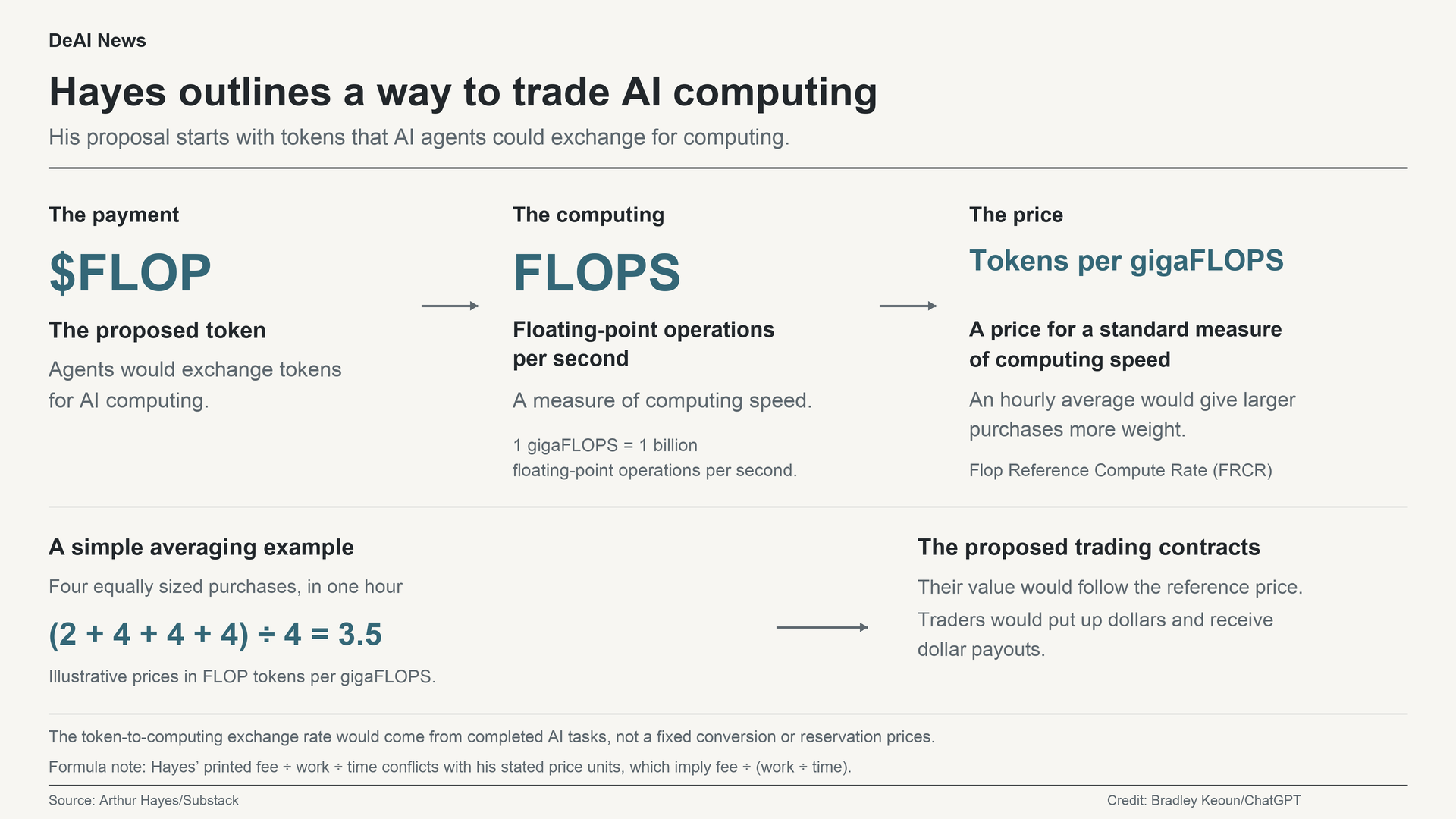
His solution? There would be a "Flop Reference Compute Rate," or FRCR. This rate would depend on the going rate for FLOPS, which stands for "floating-point operations per second," the basic unit of computation. Perhaps unsurprisingly, Hayes would price this rate in $FLOP tokens, the elemental cryptocurrency used in his new blockchain network, Flop.
"If Flop becomes the payments network for AI agents, then it follows that the $FLOP/compute exchange rate will be the global benchmark," Hayes wrote in the piece. "Derivatives can be created on top of this price."
Why it matters: Wall Street exchanges, AI startups and crypto financiers are racing to standardize trading instruments for artificial-intelligence, which some analysts predict will eventually become a widely traded commodity similar to oil.
DeAI News has covered plans to create GPU futures and live AI pricing benchmarks while reporting on the investment manager BlackRock's view that standardized capacity contracts could become tradable assets or collateral. Some experts argue that AI markets would be ideally suited to blockchain rails.
The DeAI angle
All of these discussions are very early, and experimental. For example, FLOP's status page says a developer network is running, but its token does not exist or trade. A public test network is provisionally targeted for Nov. 3.
But the stakes are high, with pioneers in these nascent markets racing to propose standards that might find favor with data center operators, compute-sharing networks, AI users, trading venues and investors.
An initial draft of a Yellow Paper for Flop Network was released on GitHub, where open-source software developers publish their projects.
The paper spells out a way for traders to reserve computational capacity, with penalties for missed delivery.
The DeAI angle: The proposal could give agents, miners and compute buyers a hedge, but the network, benchmark governance, liquidity and adoption remain unproven.
HOW AI WAS USED IN THE PRODUCTION OF THIS PIECE: I created an experimental newsroom of agent bots on Hermes desktop app, linked to a ChatGPT subscription, to research and create the first draft, in combination with custom skills that I created. The agents coordinated via a kanban board. The project required monitoring and troubleshooting that stretched over several days, and then eventually I filed the draft to DeAI News on the DistroVerse web app using the Distro Publisher MCP connector. Prior to publishing, I used DistroVerse's built-in story-editing interface to do almost a complete rewrite. I used ChatGPT in conjunction with custom skills to create a story illustration.