◈ Webinar ◈
How Distro Media Works: A Walkthrough With DeAI News & PermaPress Live webinar. Tue, Nov 17, 10:30 a.m. PT.
Save your seat.
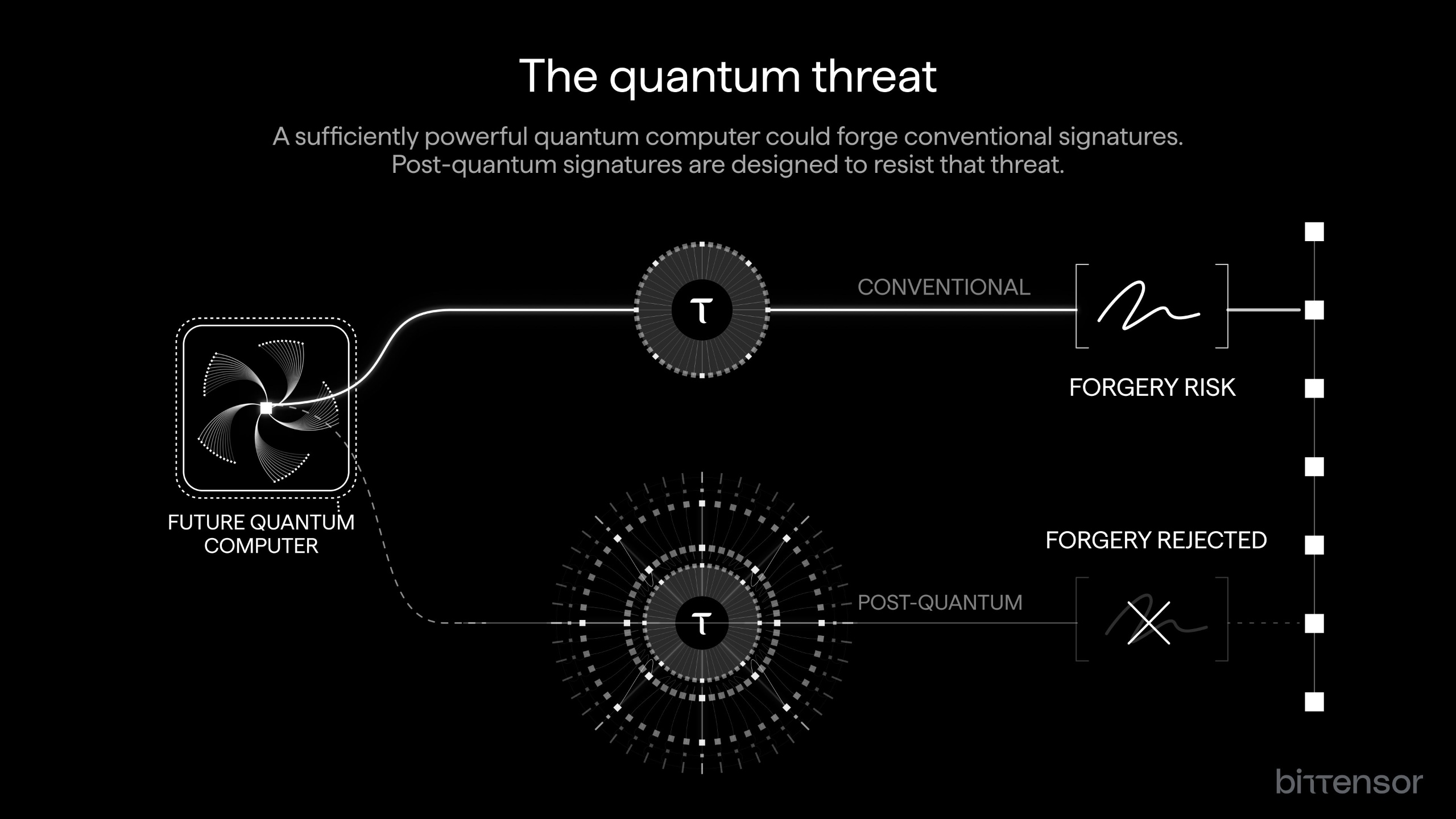
Bittensor, a crypto-powered marketplace for AI services, is adding wallet protections against future quantum computers that could break today’s security and steal users’ funds.
The move comes amid growing urgency to prepare for quantum attacks. Google has set a 2029 target for migrating to quantum-resistant cryptography, citing advances in quantum computing.
The risk has become a hot topic among developers of major blockchains like Bitcoin and Ethereum, though those networks are much larger, so coordinating their communities to push through a fix has proven more challenging and elusive.
The nimbler scale of decentralized AI networks like Bittensor may prove an advantage as project leaders push to harden the security.
The Opentensor Foundation, the nonprofit behind most development of Bittensor’s blockchain, announced the quantum upgrade Friday on the social media platform X. The software adds quantum-resistant signing options, though activation requires a separate on-chain step.
Bittensor rewards competing “subnets” supplying AI models, computing power and data. Targon, for example, is a subnet where independent operators sell computing power for AI applications, as DeAI News has reported.
Options for security level
Bittensor’s documentation describes three quantum-resistant signing options, giving wallet developers a choice between faster signing, smaller transactions and a higher targeted security level. Optional key rotation preserves account identities and balances. Existing wallets do not automatically become quantum-resistant, and rotating conventional keys does not provide equivalent protection.
Following weeks of public development, developers merged the wallet upgrade Nov. 5 into the project's main software repository. The wallet activation switch defaults to disabled.
The push for quantum resistance comes as increasingly capable AI raises another security concern: whether it could help solve the mathematical problems that protect crypto wallets, even before powerful quantum computers arrive.
DeAI News reported Oct. 8 that Ethereum co-founder Vitalik Buterin warned AI-assisted mathematics could expose cryptographic weaknesses before mature quantum computers arrive.
AI is also helping developers build defenses. Earlier coverage, citing CoinDesk, described StarkWare using AI coding to reduce estimated quantum-safe bitcoin transaction costs.
The DeAI angle: Networks rewarding AI work depend on secure wallets to protect participants’ funds and signing authority, making cryptographic upgrades part of their underlying infrastructure. So quantum resistance is crucial.