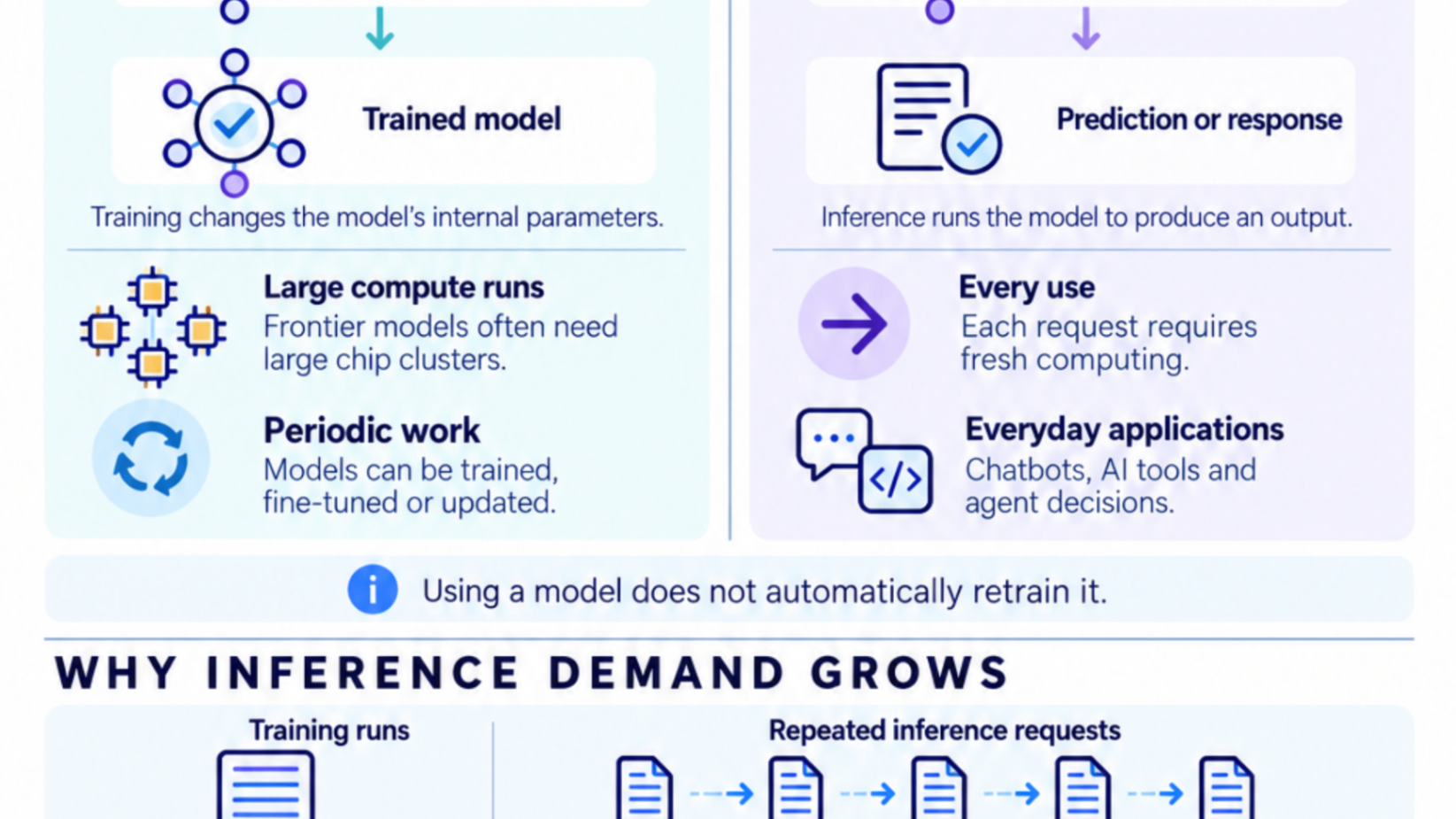
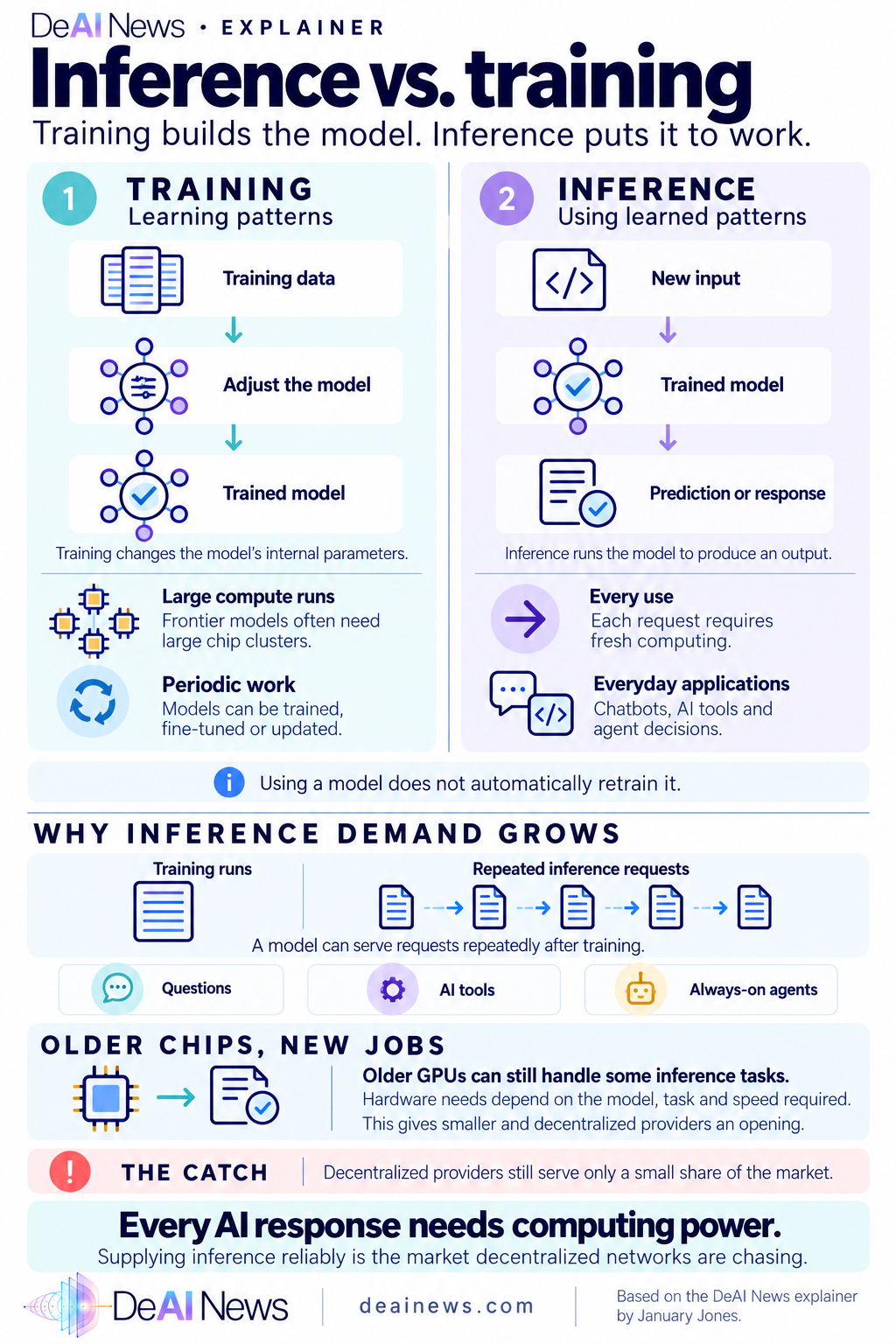
AI computing work comes in two kinds and the difference shapes where the money goes.
Training is building the model. A lab feeds a model enormous amounts of data on huge clusters of chips until it learns patterns. It's expensive and happens in big, occasional runs.
Inference is using the model. Every time you ask a chatbot a question or an agent takes an action, the model does a fresh round of computing to produce the answer. That's inference.
Greg Osuri, CEO of Overclock Labs, the main developer of AI compute network Akash, explained it on the DeAI News Journal. Training is "compute heavy, but also it's one time and done," he said, while "inference is actually when you use AI. So now most of the demand is inference."
Why demand is shifting. Training happens a few times per model. Inference happens every time anyone uses it, and AI agents running around the clock multiply that.
The money is following. Crypto financial firm Galaxy describes a new set of "inference capital markets" that route AI queries to whichever computers can handle them best or cheapest.
Old chips, new jobs. A chip that is too old to train cutting-edge models can still answer everyday questions. Decentralized GPU cloud Aethir describes a chip's life cycle as moving from training "down a value cascade" to handling queries.
That gives smaller and decentralized networks an opening. Inference doesn't always need the newest hardware in one giant data center.
Projects are pivoting to it. Peer-to-peer computing project Ocean now calls inference its "flagship capability" and says it's "the capability we have been building toward since day one."
Ocean pitches hourly chip rentals for heavy users. The math, it says, "gets considerably easier when you see the number before the session starts rather than after it ends."
The catch. Decentralized providers are still a sliver of the market. Galaxy found in July that on-chain players served just 0.5% to 1% of AI jobs routed through the popular app OpenRouter over three months.
Why it matters. Whoever supplies inference cheaply and reliably sits between users and AI every time they use it. That's the market decentralized networks are chasing.
Read more: DeAI News Journal: The Money Behind DeAI · Galaxy sees growing role for blockchain in trillion-dollar AI markets · Used GPU prices supported by decentralized AI networks, Aethir argues · Ocean expands chip-rental network to handle AI user queries
HOW AI WAS USED IN THE PRODUCTION OF THIS PIECE: I drafted this explainer with Claude, which pulled the source stories from the DeAI News archive through the Distro Publisher MCP connector and applied the Distro house-style rules. I checked every quote and figure against the original stories and the DeAI News Journal transcript.