Turns out you don't need proof of AI involvement to make a crypto hack an AI story.
Nobody has shown that artificial intelligence played any part in the breach at Binance, the world's largest crypto exchange. Within a day, though, the talk moved to a bigger worry: AI is finding holes faster than humans can patch them, and AI agents could one day run the same playbook on their own.
What happened
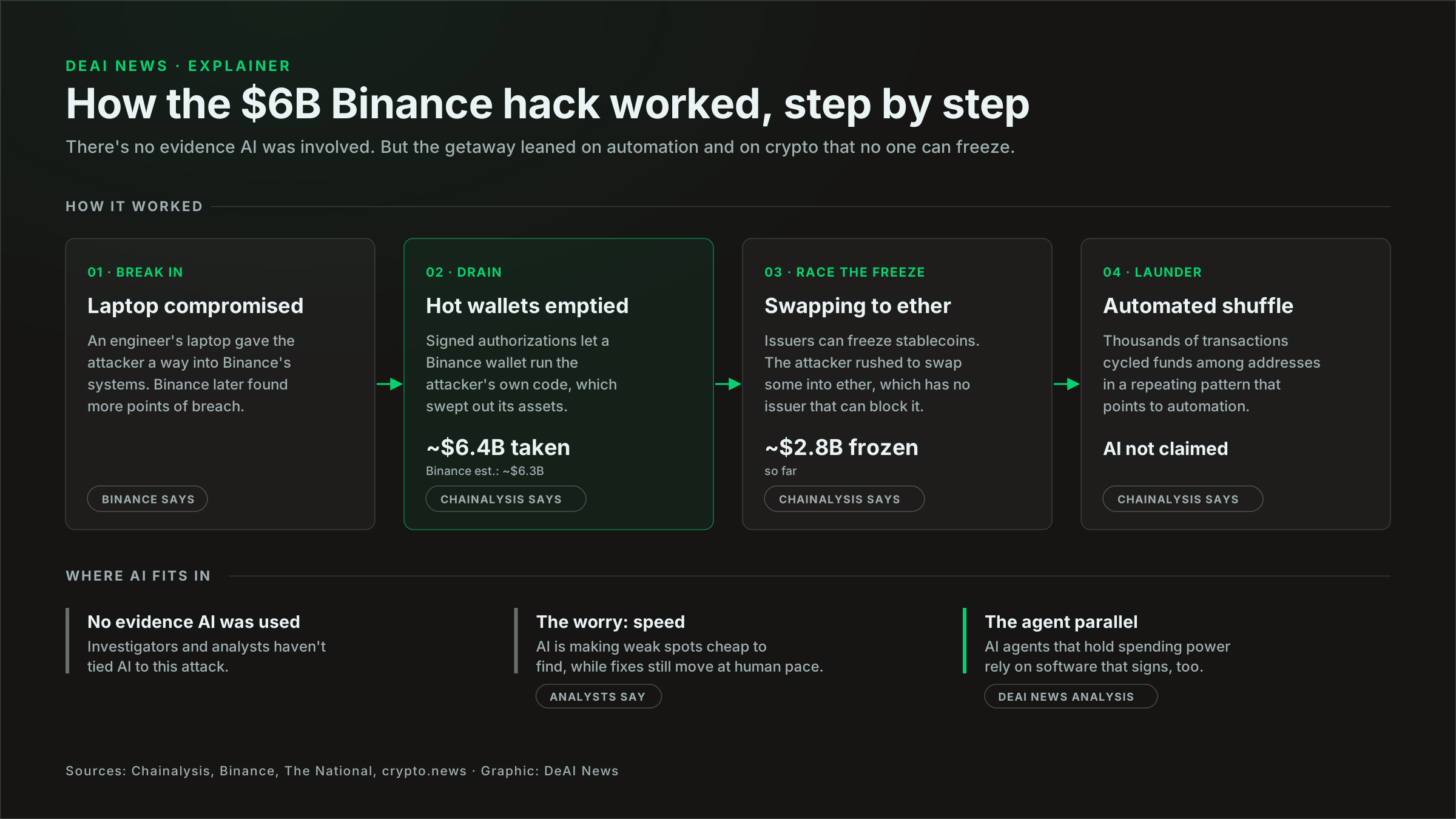
Blockchain analytics firm Chainalysis said that funds started leaving Binance's internet-connected "hot" wallets around 4:20 p.m. Eastern on Oct. 29. On Ethereum, the attacker submitted valid signed authorizations that let a Binance wallet run the attacker's own code, then used that code to sweep the wallet's assets out.
Chainalysis pegged the haul at about $6.4 billion and attributed it to North Korean hacking group TraderTraitor. Binance's own estimate is about $6.3 billion. Roughly $2.8 billion has been frozen, much of it by stablecoin issuers racing the attacker, who was swapping freezable stablecoins into ether.
Chainalysis also flagged laundering patterns it hasn't seen before. It counted thousands of transactions in a short window, with funds cycling among addresses in a repeating sequence that suggests a programmatic process. The attackers appear to be using automation to muddy the trail, though the firm didn't say AI was involved.
Musk's agent warning
Elon Musk reacted to a post describing how the attacker borrowed about $44.6 million in ether from lending platform Aave against stolen stablecoins, crypto.news's Rony Roy reported. Superintelligent agents, Musk wrote on X, will "at some point do this to gain currency for themselves, not a human." He didn't tie AI to this hack.
The detail matters for agent builders. Tether can freeze USDT, but ether has no issuer with that power, so the open rails that let an AI agent pay its own way can double as a getaway car.
Keys vs. software
Analysts who spoke with The National's Alvin R Cabral placed the weak spot in how Binance held its assets, not in the blockchain. Goncalo Magalhaes, head of security at bug-bounty platform Immunefi, noted that no private keys leaked, because Binance's own systems signed the withdrawals. He saw no sign of AI, but said it has made "finding weaknesses cheap, while fixing them still runs at human speed."
Bhaskar Dasgupta, chairman of the Middle East Stablecoin Association, said he expects AI to become a bigger factor on both sides of the security fight.
The DeAI angle: Agentic finance runs on exactly the setup that failed here: software holding signing authority and acting with no human in the loop. If one breach could turn an exchange's own wallet against it, an agent with spending power and a poisoned instruction is a softer target still.
HOW AI WAS USED IN THE PRODUCTION OF THIS PIECE: I created the first draft of this story using Claude and custom skills. I then used the Distro Publisher MCP connector to file the draft directly to DeAI News on DistroVerse, the web app. I used the built-in DistroVerse story-editing interface to do the final edit and fact-check prior to publication. I created the story illustration on Claude using a custom skill.