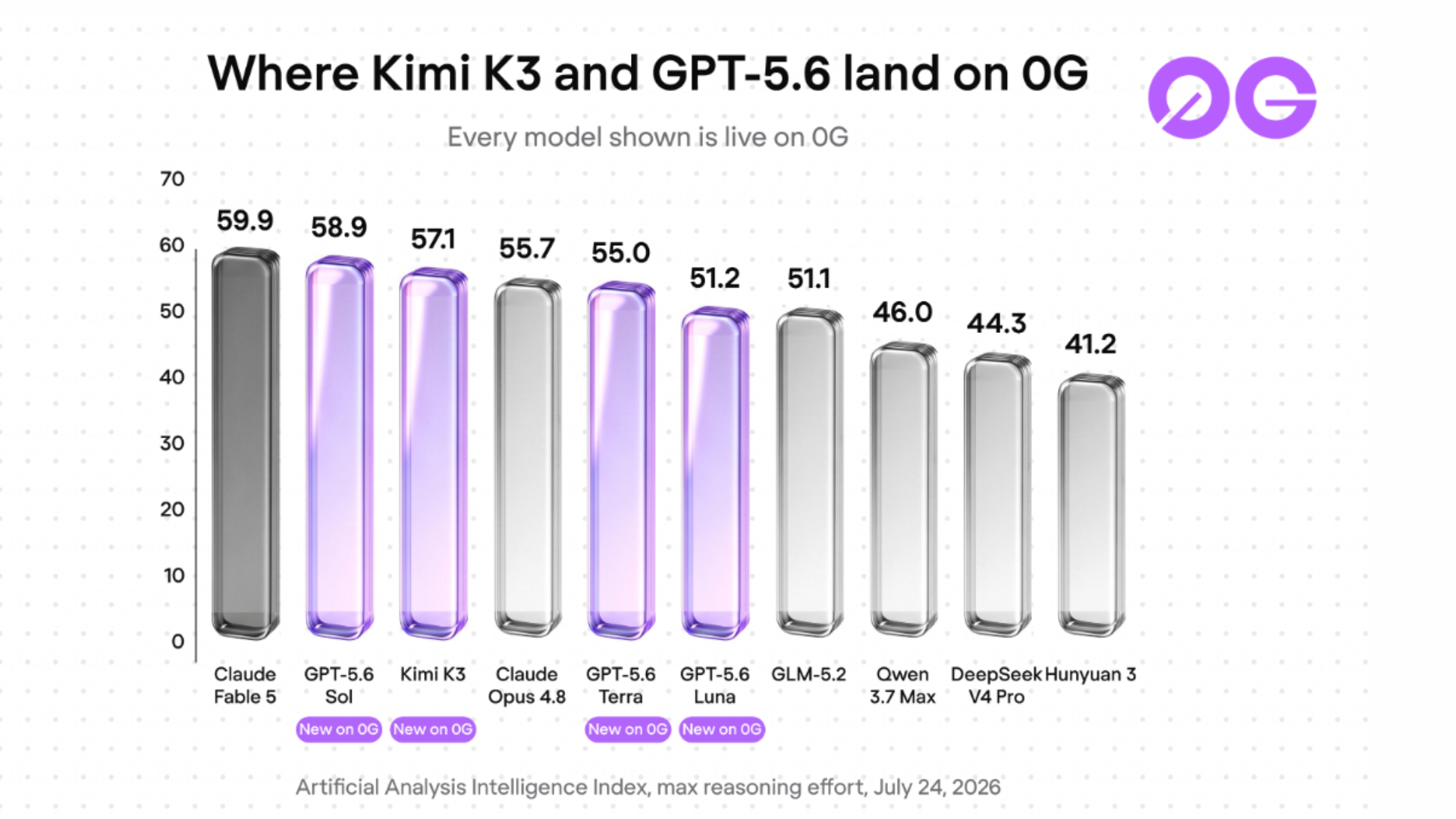
0G, a decentralized network that routes AI models over its own blockchain, has added Kimi K3, the new frontier model from Chinese startup Moonshot AI, to the roster of systems its users can tap.
The move is a notable development since the model's release has become controversial, with U.S. government officials lobbing accusations that effort included copying off of U.S. firms.
The model is now live through 0G's "Verified Routing" tier, which opens a hardware-attested path straight to Moonshot's official interface, according to a blog post dated July 25. 0G says it passes calls through at cost, with no markup.
A key promise of decentralized AI projects is that they might inherit the censorship resistance that many blockchain projects claim, so these channels for users to access the models could serve as early test cases of the thesis. It could be that the permissionless, borderless posture makes decentralized AI projects structurally more willing to carry models that have turned politically radioactive.
A similar dynamic evolved in decentralized finance (DeFi), though many projects geofenced users – limiting to certain countries – rather than take the extra legal or regulatory risk.
Kimi K3's splash
Kimi K3 is tipped to be the largest open-weight model publicly available, at 2.8 trillion parameters, and in blind "arena" tests, developers picked it over the prior generation of leading U.S. models on front-end coding tasks, though it still trailed the current flagships from Anthropic and OpenAI.
Washington has not welcomed it. White House Office of Science and Technology Policy Director Michael Kratsios accused Moonshot last week of training K3 on banned Nvidia chips and running "large-scale distillation" against U.S. models, a technique in which one system is trained on another's outputs to copy its abilities on the cheap.
Kratsios named Anthropic's Fable model as a target, as DeAI News reported last week. Moonshot has not responded to the allegations.
0G is built by 0G Labs, a crypto-AI startup that raised a $40 million seed round in November 2024 alongside a $250 million token-purchase commitment, for $290 million in total financing.
Co-founded by Michael Heinrich, the company launched its "Aristotle" mainnet in September 2025, billing itself as a decentralized operating system for AI.
0G's catalog
Kimi K3 is no one-off for the network. It sits in a catalog that already leans heavily on Chinese models, including DeepSeek, Alibaba's Qwen, Zhipu's GLM, Tencent's Hunyuan and MiniMax, listed side by side with U.S. systems from OpenAI and Anthropic.
On 0G, a Kimi K3 call settles in the network's 0G token rather than on a credit card, priced at $3 per million input tokens and $15 per million output tokens, matching Moonshot's own rates. Users can pass a "verify_tee" flag to confirm the request actually reached Moonshot and not a middleman.
"Running a frontier model today means picking a provider," the company wrote in the post. "For an autonomous agent working on proprietary code or user data, trust-by-policy is the weak link."
The listing does not park Kimi K3's weights on 0G's own servers; the network is routing traffic to Moonshot's API, so access still ultimately depends on the Chinese company keeping that door open. But it underscores how hard these models are to wall off once a decentralized layer decides to plug them in.
(HOW AI WAS USED IN THE PRODUCTION OF THIS PIECE: The first draft of this story was written on Claude Desktop using a custom blog-rewrite skill, adapted with added background research on 0G Labs and the Kimi K3 controversy. I then used our Distro Publisher MCP connector to file the story as a draft to DistroVerse, our web app. I used the native (non-AI) story editor in DistroVerse to edit the story, and checked the facts prior to publication.)